The instructor
drew two pictures on the chalkboard and claimed that in Euclidean geometry
through the point outside the line you can draw only one line parallel to the
given one but in Lobachevsky geometry (she used this name for hyperbolic
geometry) those three intersecting lines
are parallel to the one line below. „Why?” was this picture on the chalkboard
showing what the instructor said it was supposed to show? She said, „You have
to use your imagination or make an assumption.” How could I make an assumption
if my previous experience told that only one of these lines would be parallel?
, or how can I imagine something if I do not know what to imagine? Fortunately
this was a pass/fail class. I passed –
otherwise I would not be here – but I hoped I would never have to think about
hyperbolic geometry again.

It was not in my
dreams that 20 years later, I would be, on the other side of the world, faced
with the task of teaching Fall semester hyperbolic geometry at Cornell
University. There was no way I could use my previous „experie
nce”, so I looked to what
others were doing. In June 1997, I attended a week-long workshop led by David
Henderson, who explained and demonstrated hyperbolic geometry showing a paper
model that he had learned to make from Bill Thurston. My fingers itched to touch it, but I was not
allowed to touch, because this fragile
little thing would be easily destroyed. At this point, it became clear to me
that I had to figure out how to make something more durable. It looked like,
once again, that I would have to turn to my imagination. The problem I faced
was how to present exponential growth in tactile way.

I remembered how as
a child I was first introduced to powers of two with an example how rumors
spread – first I tell you something, then the next day each of us tells just
one more person, the next day there are four of us who tell just one more
person and so on. Nowadays of course it is much simplier to explain – it is
enough to mention Ponzi scheme, and everybody gets the point. Right there
during the workshop I graphed powers of two and then my „Aha!” Moment happened –
the graph looked like a crochet pattern!
The same night I began to
crochet it. Powers of two grow very fast, so I decided to slow it down a
little. The first crocheted hyperbolic plane was born with a very simple
„recipe”. Instead of crocheting back and forth with each row as I might for
something flat, like a scarf, I would add an additional stitch into every third
stitch that I came across from the previous row. So instead of „crocheting” y =
2x I crocheted y=(3/2)x.
This model came out too ruffled, so I figured the
exponential growth of the number of stitches should be slowed down more, making
the ratio even closer to one and I tried others, such as 9/8, 12/11, ...
The next models
became something that I could use to finally figure out how lines on a
hyperbolic surface look.
So, to go back to the original question. How do you
get a straight line on a hyperbolic plane? Well, how do you do it on a flat sheet of paper? If you can fold it – that gives a perfect
straight line.
It turns out, that I can do the same thing
with my crocheted hyperbolic plane and voila! – here is a straight line on it!
...
And finally there
it is! I have in my hands a tangible picture that I had so much trouble
imaginining as a student!
On a hyperbolic
plane I can have infinitely many lines through this point and they all will be
parallel to the given line. The solution to the puzzle of why this is possible
comes through fingers touching it: by folding, I can really see that any of
these pair of parallel lines is closest at one point then on both sides they
diverge away.
Why do we care
about hyperbolic plane? It is rich and beautiful. It helps us to better understand
Euclidean geometry. It also helps to understand shapes in nature, which we will
see later, and helps us to think about the shape of our Universe, the problem
that has puzzled people for thousands of years and still is an open question.
If we have a
surface or space that is the same everywhere, then we can define geometry that allows
to describe it. The simpliest ones - Euclidean
plane, sphere, and hyperbolic plane are all two dimensional surfaces with the
constant curvature therefore they each can have their own geometry.
What is a curvature? We know that numbers can
be positive, negative, and zero. In early 19th century Carl Friedrich Gauss
suggested to use similar characteristic for surfaces. Let us use some tilings.
We can cover floor or walls with
hexagonal tiles. Notice that - at every vertex 3 regular hexagons come together
and the result is flat surface. So we say that Euclidean plane has zero
curvature.
If at
every vertex I remove one hexagon and replace it with pentagon, then surface
starts to bend and eventually closes) This is one way how soccer balls can be
made. This is the example of constant positive curvature or sphere.
If instead of
pentagons I use regular heptagons – 7-sided polygons – the surface bends again
but this time it is not closing- this is another model of the hyperbolic plane
which has constant negative curvature.
Keith Henderson, a mathematics teacher, was explaining a notion of
curvature to his class this way, and I really liked it.
If you do not
want to crochet, you can use these paper models but I will use crochet ones to
show some more interesting properties of
hyperbolic geometry.
We all learned in
school that the sum of interior angles of a triangle is 180 degrees. That is
true only on a Euclidean plane or zero curvature surface. On a sphere triangle will have angles which
add up to more than 180 degrees. You can check this by cutting an apple.
On a hyperbolic
plane, a triangle will have interior angles which add up to less than 180
degrees; and it means that we can have a triangle which has the sum of interior
angles almost zero!
My husband is a
topologist and as soon as I figured out how to crochet hyperbolic plane, he said
that I have to make this model which he knew from a theory but never had in his
hands. On a hyperbolic plane it is possible to construct a regular octagon with
all interior angles 45 degrees. (In Euclidean plane it would be a stop sign.)
If we identify or „glue” its sides accordingly
we get so called „hyperbolic pair of pants” which in 4th dimension would be
possible to turn into a two hole torus. If organizers would have provided me
with it here, of course.
In first grade when I
learned how to write numbers I had to do that neatly in a notebook with square graph
paper.
It is impossible
to have a square grid in hyperbolic plane – if we fold a regular polygon so
that all angles are right angles we end up with right angled pentagons! And we
can go even further and have right angle hexagons, heptagons and so on, but no
squares on the hyperbolic plane!
We are
familiar with the flat plane and sphere
but surfaces with negative curvature are no stranger to us. Look at nature!
These forms have been there long before mathematicians learned how to describe
them!
Without any
theory nature has figured out how to fit maximum surface area into minimal
volume.
When I started
these demonstrations with crocheted models of hyperbolic planes 15 years ago I
received mixed reactions. My students
were excited about having hands-on experience, and many college professors
started to use it. But there were people
who said that I am not serious enough – mathematicians do mathematics not
crochet! There is still alive the stereotype that mathematics is an austere and
formal subject concerned with complicated and confusing rules and therefore it
is accessible only to very few chosen people. Perhaps that is because we are
teaching mathematical facts and results but keeping it almost secret how
actually they are discovered. In school we are rarely taught mathematical
thinking.
It is
not only mathematics, crochet suffers from a steoreotype as well like – crochet
is what women do when they have nothing else to do. When in 2001 we tried to
convince the editor of The Mathematical
Intelligencer to accept a paper about crocheting hyperbolic planes, he was
very hesitant to do so. He said – how it will look – crochet instructions in a
math journal? Eventually he agreed. At that time he did not really believe my
argument that crochet is useful for making mathematical models and somebody
else can be inspired to use it also. But it did!
Three years later
on the cover of the same journal there was a crocheted model again.
Hinke
Osinga and Berndt Krauskopf were not shy to use crochet to create a Lorentz
manifold using computer generated crochet instructions. This beautiful surface
illustrates how chaos arises and is organised in various systems. They were
inspired to use crochet because of seeing crocheted hyperbolic planes.
I made my first
model, then next, then the whole classroom set, then other people wanted to use
these models in their classrooms. I kept continuing my experiments – changing
ratios, forms, colors. It was interesting because before I started a piece I
had no idea how it will look at the end. Was it becoming an obsession?
In early 19th
century Wolfgang Bolyai warned his son Janos who became obsessed with the idea
of creating a new geometry:
For God's sake,
please give it up. Fear it no less than the sensual passion, because it, too,
may take up all your time and deprive you of your health, peace of mind and
happiness in life.
I used this quote to warn my audience, but I should’ve
listened to it myself! Somehow once people start crocheting hyperbolic planes,
they cannot stop. Exploring hyperbolic geometry using crochet models became
very popular and got out of mathematical circles - it has become quite viral.
Margaret and
Christine Wertheim learned from me the idea of explaining hyperbolic geometry
through crocheted models and have widely used it in connection with their
project Hyperbolic Crochet Coral Reef spreading these ideas worldwide,
including a TED talk "The Beautiful Math of Coral" in 2009. By now their project has involved more than five
thousand crocheters around the globe and the numbers just keep growing.
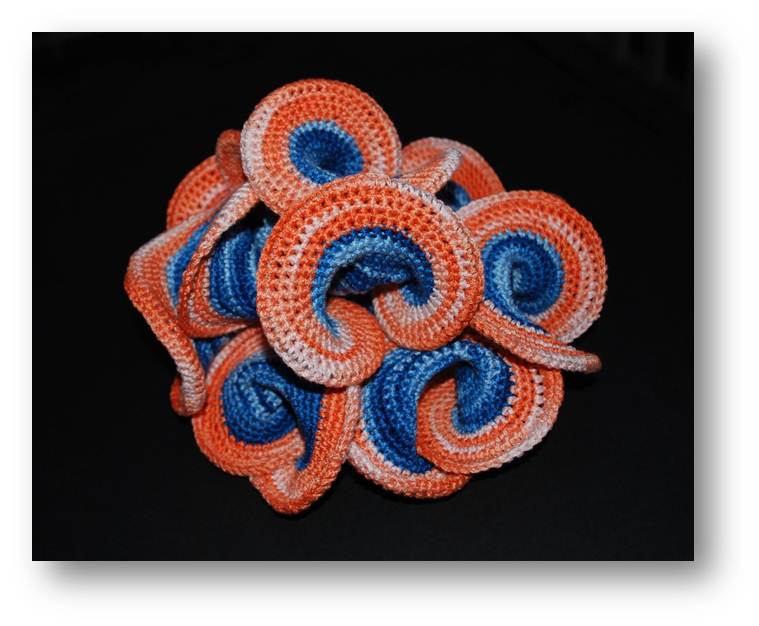
This is
a fragment of Latvian Project "From coral reefs to Baltic Sea" on exhibit
here in Riga in 2009. Fortunately crocheting
hyperbolic planes is not depriving people from their health and peace of mind
but making them happy to become connected through the simple crochet pattern
used in many creative ways – in physics, biology, in design, even
psychotherapy, music, and poetry.
Often after
somebody has learned that I am a mathematician, I hear – oh, I was so bad at
math in school! In fourth grade I did my best to draw „Memories of my summer”.
Art teacher glanced at it and told me that I might be the best student in math,
but I have no artistic eye and my drawing is horrible. I liked to draw and was
sad about such teacher’s prejudgment, so I grew up convinced that I am really
bad at art.
It was like a
lightening from a clear sky when in March 2005 while gardening I received a
phone call from Washington. Binnie Fry asked me if she could have some of my
works for an art show Not the Knitting You Know in 1111 gallery on Pennsylvania
Avenue. Yes, the same one that connects the United States Capitol to the White
House. I authomatically said – yes, of course, but afterwards started to think – what should
I do now? Before I used craft yarn for it was cheap and durable, and my models
were made for use in geometry class not the art gallery. I did feel very scared
but I had to keep my promise. First I went to the local yarn store to find some
nice yarn, then I had to learn how to be an artist.
Since then I have been
invited to participate in more than 20 art shows. One of my pieces even is
included in Textile Collection of Cooper-Hewitt National Design Museum in New
York City. I wish I could talk to my art teacher now. I wish no child would be
told – you are no good at math. That is why I keep crocheting and talking about
these hyperbolic planes.
Mathematics is
not scary when you can touch it, think about it in fun ways, or even better –
make it yourself. Charlotte Henderson after editing my book Crocheting Adventures with Hyperbolic Planes
decided to crochet one herself. She said: „Once I had made one for myself, I
was able to believe hyperbolic geometry properties that I had previously accepted with my head
but not my heart.”
At the opening of Latvian Crocheted Reef
exhibit I met several young people with learning disabilities who also had
participated in the project. They wanted to know what is hyperbolic geometry. I
showed them what I showed you and they understood. And afterwards one of them
said the best praise I have ever heard
about my work: „Thank you for making us feel as part of others.”
Bill Thurston wrote in a forward to my book: „Mathematics is art of
human understanding...Mathematics sings when we feel it in our whole brain.
People like music but they are afraid to sing. You only learn to sing by
singing.”
Dare to make unexpected connections and be
ready for joy and tears, praise and rejection!
How about some adventures with the hyperbolic planes?


 photo David Henderson
 photo by Kelly Delp