Tuesday, February 10, 2026

Ruth Asawa retrospective in MoMa


I will not be able to describe this Ruth Asawa's (1926-2013) retrospective better than it was done by  Julian Lucas in The New Yorker (Nov.24, 2025) which you can read here.
 These will be just some of my personal reflections.


I do not remember whether I first saw Asawa's sculptures - San Francisco museum of modern art? or  was it in Crystal Bridges in Arkansas? The largest collection of her wire sculptures I saw before this retrospective at MoMa was in the exhibit at David Zwinger gallery in NYC in 2017. I was stunned by the amount of repetitive work put in all those sculptures. Seeing those works again in MoMa felt like meeting something familiar but no less impressive. What I learned now was that she had six children and she had them sometimes helping her. As she said in the video shown - "I had to figure out for them what to do." Ruth Asawa involved in making art not only her own children but she was teaching others too - that was mostly drawing and making sculptures. (More about that in the story I mentioned above).

Many times I was asked a question why I haven't created my hyperbolic crochet works in wire. I tried to crochet wire and it did not work. I know artists who have created crochet sculptures (Blanka Sperkova, Deanna Gabiga, for example) but working with wire wasn't for me. 

Ruth Asawa had studied some geometry and that I have always felt in her works. In this show I found fascinating not only look at her sculptures but also to pay attention to shadows - this subtle movement from three dimensions to two and back, in some corners reflections were different projections. 
This is Ruth Asawa's piece that has negative curvature 

This one is very much like hyperbolic plane.
Another example of negative curvature

Here is a nice documentary about Ruth Asawa's drawings.
And another documentary showing how Asawa was working.


Sunday, May 25, 2025

Woven Histories and Modern Abstractions


On a day when glorious spring in NYC decided to remind about nasty rain and chill I found warmth in MoMa where I went to see the exhibit Woven Histories and Modern Abstractions. "Threads were among the earliest transmitters of meaning", wrote Anni Albers in 1965. 
The exhibit starts with these two little pieces by Sonia Delaunay which are fascinating by their simplicity. Here is an old but very interesting piece about her.
Anni Albers has said that "a thread is perhaps the earliest transmitter of the meaning" - I love her work which can be seen in several places through this exhibit.


This Agnes Martin's untitled oil on canvas painting from time when she lived and worked in a loft building in downtown Manhattan with several painters and textile artist Lenore Tawney with whom she developed close personal relationship, mutually informing each other's art practices.


Lenore Tawney Dark Rays - in 1964 Tawney embarked on a series of works on a graph paper that conflate line and thread, drawing and waving.
Interesting work by Gego but hard to photograph it.
I am happy to see Ruth Asawa's works again and again.
After lately seeing so many Yayoi Kusama's colorful polka dotted works this painting was a surprise to me.
Ed Rossbach is well represented in this exhibit.
Venezuelan artist Gego (Gertrud Goldschmidt, 1912-1994) is represented by several very different works in this exhibit. Cut and woven paper strips are something many have done in elementary school as a craft project but this is on such high level.
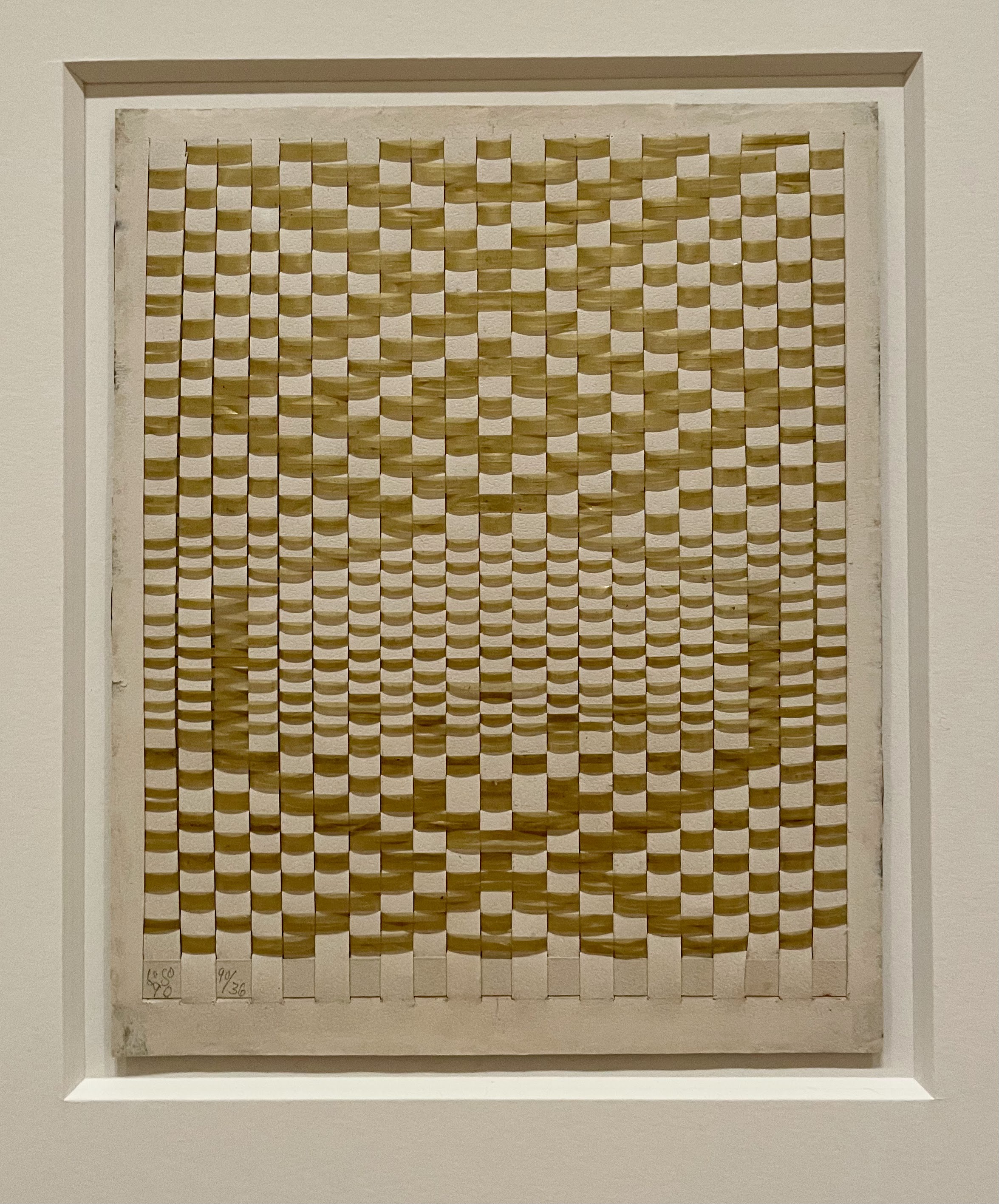
Another surprise for me was this Ruth Asawa's untitled tempera painting on board.
Ed Rossbach's Tagging Tape Lace - polyethylene
These two colorful works are by Marilou Schultz who is the fourth generation of storied family of Navajo weavers. In 1994 Intel Corporation commissioned her to weave a replica of their Pentium microprocessor using traditional techniques. They used an image of this weaving in a publicity campaign that stressed affinities between Navajo aesthetics and the design of computer hardware. Here she talks about her work.
These Cojini are from a collection of Spanish artist Teresa Lanceta who in the 1980s traveled to Atlas Mountains in Morocco. There she encountered Berber women and learned about their weaving practices.
Jeffrey Gibson is a member of the Missisippi Band of Choctaw Indians and Cherokee. H assemled this ceremonial garment from what he calls a patchwork of materials.

Very mathematical crochet by Andrea Zittel Single Strand Shapes Forward Motion with 90 degree and 180 degree Rotations.(2009) The artist explained that in  a series each single strand and shape begins with a set of permissions or rules. There is never a set plan for what the finished work will look like, so all decisions are made in the moment as long as they qualify within the prescribed set of allowed actions.
Just a few "dresses" or wearable (?) art in this exhibit. This one is by Polish artist Paulina Olowska.

More Anni Albers
Hannah Hoch  two Embroidery Grid collages


Installation images will give a better feel for this amazing exhibit.


Saturday, October 16, 2021

Line and shape in Native American Art


This week a road took me to Cooperstown where I visited Fenimore Art Museum. One of  current exhibits there is Elegant Line/Powerful Shape: Elements of Native American Art. As always - looking for geometry in all its various beautiful forms - I found these objects as true expressions of meanings through geometric elements. Native American artists communicate with their audiences visually - using variety of materials to create lines, shapes, colors to convey the beauty of the world.

On this Dance Kilt (ca 1900-1915, New Mexico)  the zigzag line forms a body of a supernatural being Avanyu, or Plummed Serpent, representing a lightening bolt, V lines inside represents a rainbow. Along the bottom of this kilt is a line of tin cones, that sounds like falling rain while dancing.


This birchbark Wigwam Model (ca 1847-1852, Anishinaabe, Ontario) is decorated with stylized floral and geometric motif made by series of lines.

Against a red and green wool white glass beads create two types of lines in this finger woven Sash (ca 1780-1830, Iroquois, Great Lake region). This type of sash was often worn around the waist to secure a coat or worn across the chest to signify high status.

To make this Belt (ca 1800, probably Manitoba Ojibwa) quills were flattened and then folded between threads on a bow-loom to create a line design.

Olla baskets were the most important type of container for the Yavapai as they are sturdy and lightweight. On this Olla Basket (ca 1915-1920, Yavapai, Arizona) the shapes of deer and humans are made from devil's claw utilizing negative spaces on triangles.

This olla basket - jar (ca 1900-1910, Apache, Arizona) is woven using three-rod coils, willow, devil's claw, red yucca root.
Basket (ca 1920) by Elizabeth Hickox (1875-1947). Her classic designs were achieved by overlaying the foundation with yellow-dyed porcupine quills and black maidenhair fern stems.
This type of jar was perhaps used to carry water from a river. It was made by Mimbres people, SW New Mexico, ca. 1000-1150. These farmers produced pottery which are considered the most aesthetically sophisticated of the ancient art in North America.

Velvet bandolier bag's (ca 1890, Ojibwa, Great Lakes) elaborate design is created using thousands of colorful glass beads imported by Europeans.

This was one of the oldest object I saw in this collection (ca 1200), unfortunately I lossed its description and could not find it also in online exhibit.

The ceremonial masked dances of Alaska's central Yup'ik region honor and express gratitude to animals' spirits or souls and petition animals to be plentiful in coming season.


Just a little glimpse in this large collection. All 876 objects of which can be explored online here.

I loved this 1750 Mohawk bark house recreated at the lakeside.