Saturday, March 14, 2020

The Modern Thread

Have you heard about Marie Cuttoli? I have not until my recent visit to Barnes Foundation where I was fortunate to see exhibit The Modern Thread from Miro to Man Ray. I was fortunate a) because it is great exhibit; b) Barnes Foundation is temporarily closed due to Covid-19 pandemic.

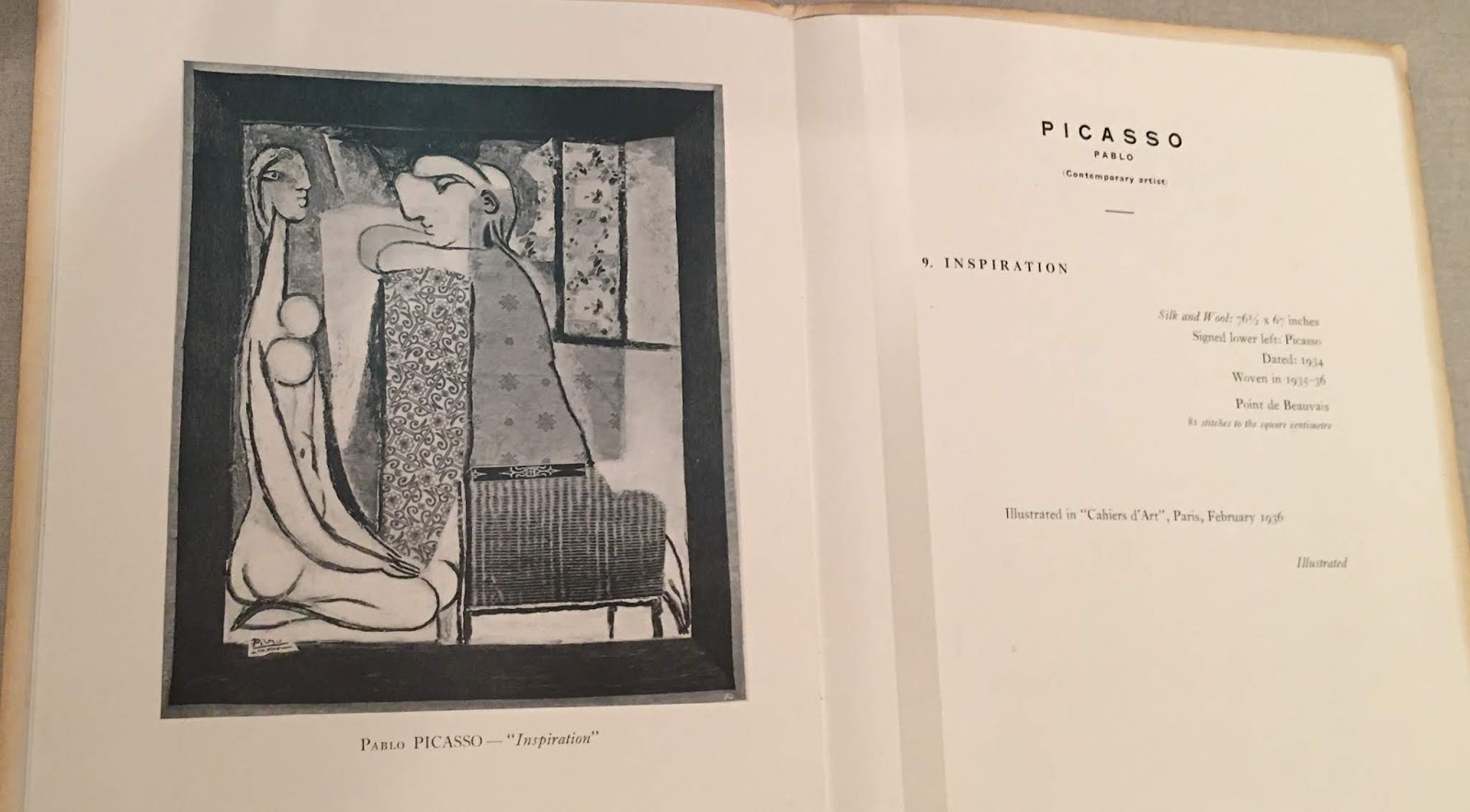
In 1930s Paris Marie Cuttoli (1879-1973) convinced the most celebrated artists of her time - including Picasso, Miro, Leger, and Man Ray - to create designs for the historic tapestry workshops of Aubusson, France. Cuttoli's venture gave new life to an artisan tradition and brought modernism to new audiences. In Barnes Foundation exhibition it is possible to see designs for textiles, which they call cartoons (some of them later were sold as paintings), and tapestries made from those designs. Why the name cartoon? Because those designs were made as large as the tapestry will be woven and put underneath, so weaver could follow the pattern.
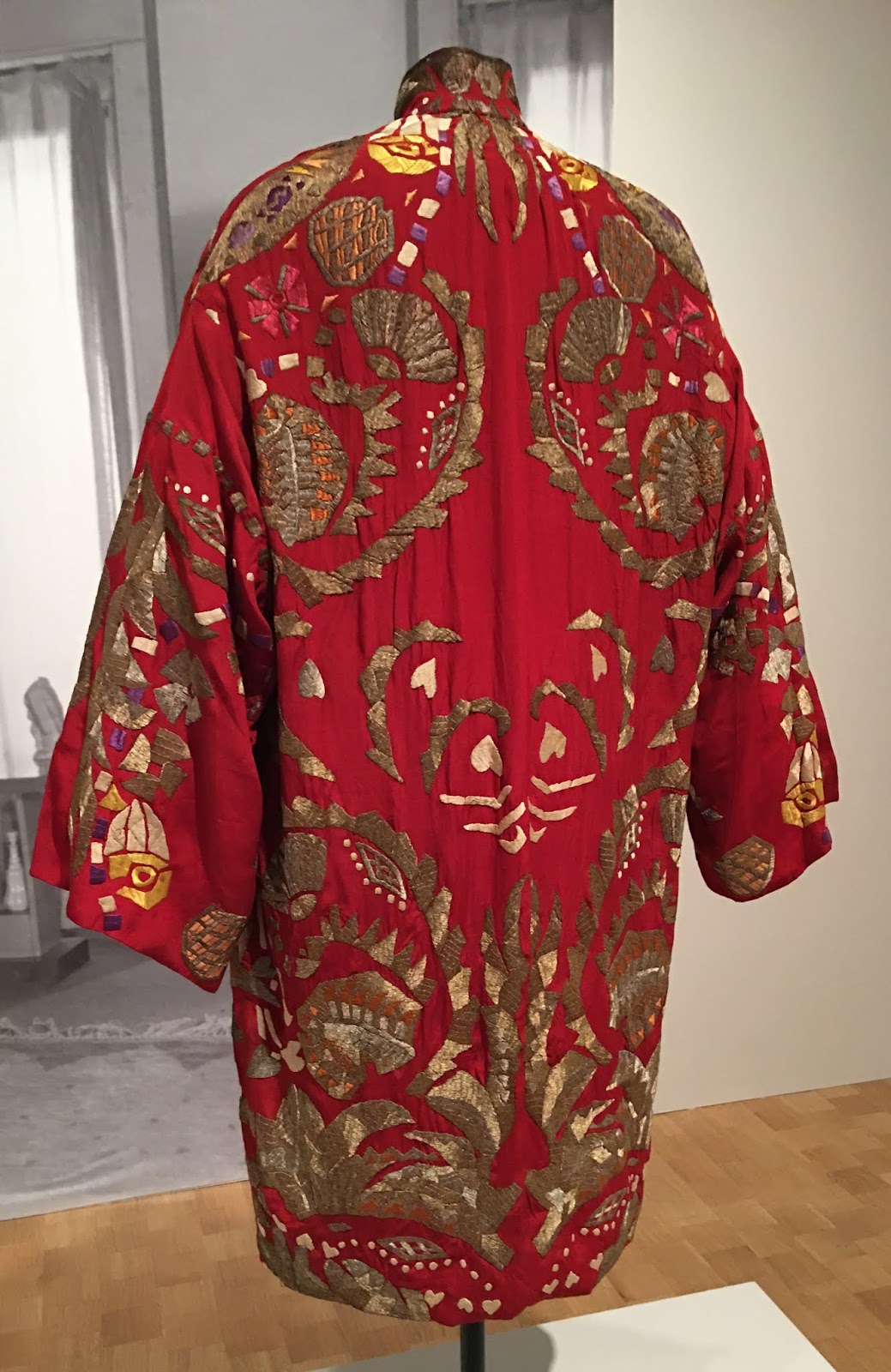
The first object is this fabulous  evening dress, embroidery for which was designed by Natalia Goncharova, Russian avant-garde painter whose costumes for The Ballets Russe Cuttoli admired. In 1922 Marie Cuttoli opened her fashion house and boutique Myrbor in Paris, in the same neighborhood as Chanel and Lanvin. In 1926 Cuttoli renovated her boutique and rebranded it as Galerie Myrbor, presenting modern art alonside fashion and rugs.
The red silk jacket's embroidery design is also attributed to Natalia Goncharova.


Still Still Life with Guitar by Georges Braque and a tapestry 
Braque incorporated sand in his oil painting. In the tapestry that effect is done by light absorbing wool and light reflecting silk.


Cuttoli's venture related closely to mural decoration, a topic that fascinated artists in 1930s. Tapestries had many of the same qualities as murals with the added benefit of portability. Designing for Cuttoli pushed artists to take their work in new directions, experimenting with scale and process alike. Man Ray used a rayograph in his design, bringing an innovative photomechanical process into an artisan tradition. The architect Le Corbusier, who was flattered to join a group that included Picasso, Braque, and Leger, worked up sketches for a cartoon titled Marie Cuttoli, an experience that informed his later conception of tapestry as mural for the modern era.
The back side of the tapestry shows that the weaver got colors very well but over the years the tapestry has faded.


Tuesday, March 3, 2020

DREAMS

by Mark Strand (1934-2014)
Trying to recall the plot
And characters we dreamed,
     What life was like
Before the morning came,
We are seldom satisfied,
     And even then
There is no way of knowing
If what we know is true.
     Something nameless
Hums us into sleep,
Withdraws, and leaves us in
     A place that seems
Always vaguely familiar.
Perhaps it is because
     We take the props
And fixtures of our days
With us into the dark,
     Assuring ourselves
We are still alive. And yet
Nothing here is certain;
     Landscapes merge
With one another, houses
Are never where they should be,
     Doors and windows
Sometimes open out
To other doors and windows,
     Even the person
Who seems most like ourselves
Cannot be counted on,
     For there have been
Too many times when he,
Like everything else, has done
     The unexpected.
And as the night wears on,
The dim allegory of ourselves
     Unfolds, and we
Feel dreamed by someone else,
A sleeping counterpart,
     Who gathers in
The darkness of his person
Shades of the real world.
     Nothing is clear;
We are not ever sure
If the life we live there
     Belongs to us.
Each night it is the same;
Just when we’re on the verge
     Of catching on,
A sense of our remoteness
Closes in, and the world
     So lately seen
Gradually fades from sight.
We wake to find the sleeper
     Is ourselves
And the dreamt-of is someone who did
Something we can’t quite put
     Our finger on,
But which involved a life
We are always, we feel,
     About to discover.

Monday, February 17, 2020

Strands to Stitches

Let me introduce you to Ithaca fiber artist Saundra Goodman. Her colorful crochet creations are currently on a show in State of the Art Gallery in Ithaca.
I first noticed these three pieces through the window and from afar the first thought was - are they quilts? When I looked closer, I could see very fine crochet stitches.
Then there are these sculptural pieces.
On Saturday February 15th I went to Artists talk. I was curious to learn about Saundra's practice. 
Since she was a child she was fascinated by knitting and crochet because that was a way to create something tactile.
In Saundra's hands strands become her palette and she is creating her own colors by combining these various strands.
These two pieces originally were like the previous one but then Goodman decided to make something more interesting and she cut them to create quilt like pattern. Cutting crochet work? That is really something brave! Even after Saundra explained me how she did it I don't know if I will ever try to do it with my pieces.


Currently Saundra is experimenting with stitches what she calls vertical crochet - she created this technique to be able to make more three-dimensional works and have more adventures with crochet.

Saundra Goodman was born in New York City. Soft spoken and very kind, it is hard to believe that she is a former Woman Marine who served in Vietnam War. She holds a degree in psychology from University of North Florida, studied drawing and painting in School of Visual Arts in NYC. You can learn more about her work from her website https://www.strandstostitches.com/